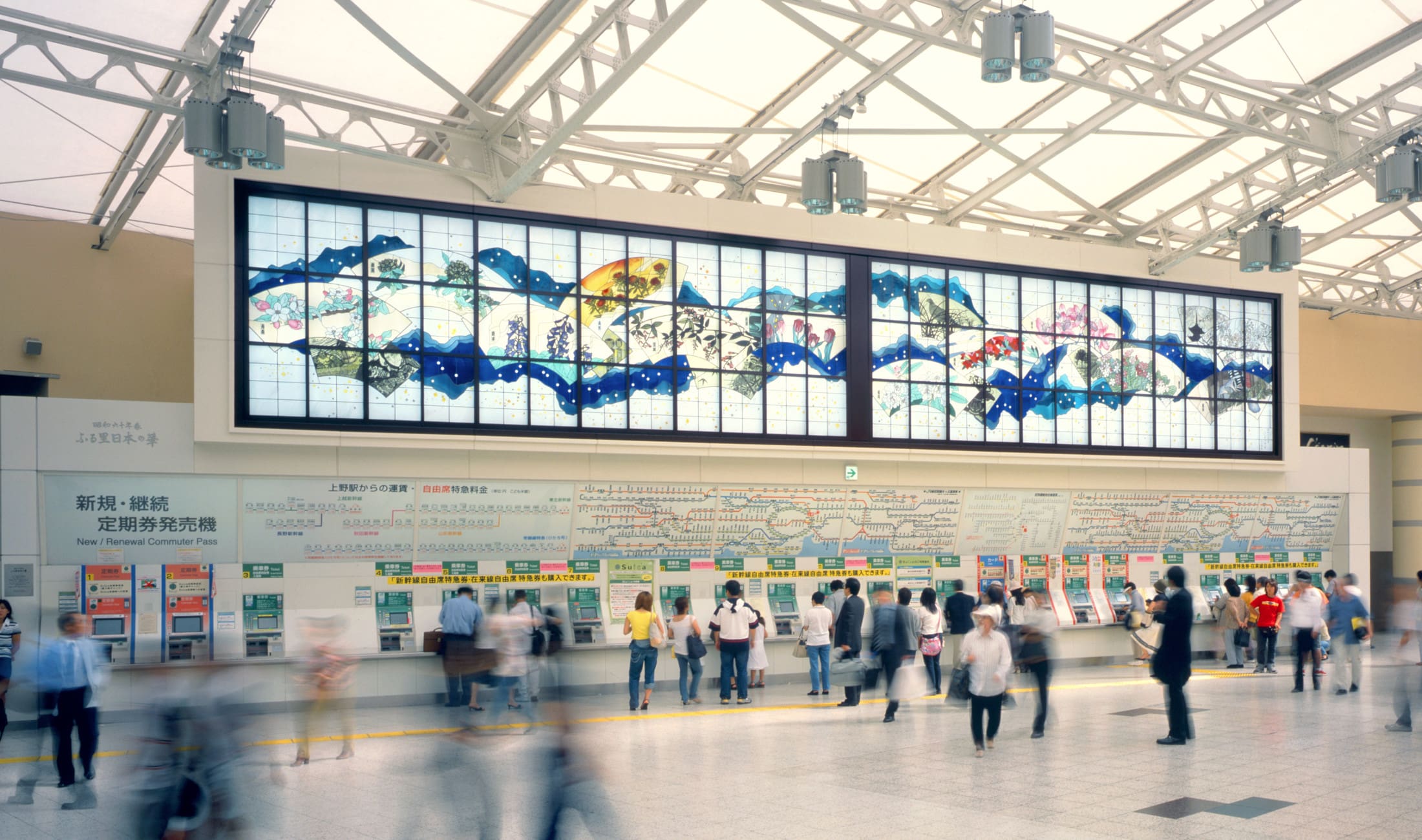
Spring in 1985, Japan’s Flowers at Hometowns (Currently not exhibited)


Original Painting and Supervisor |
Japanese-style Painter HIRAYAMA Ikuo HIRAYAMA Ikuo |
|---|
1985
H2.8m × W17.7m
JR East Ueno Station (Currently not exhibited; scheduled for reinstallation at the same station)
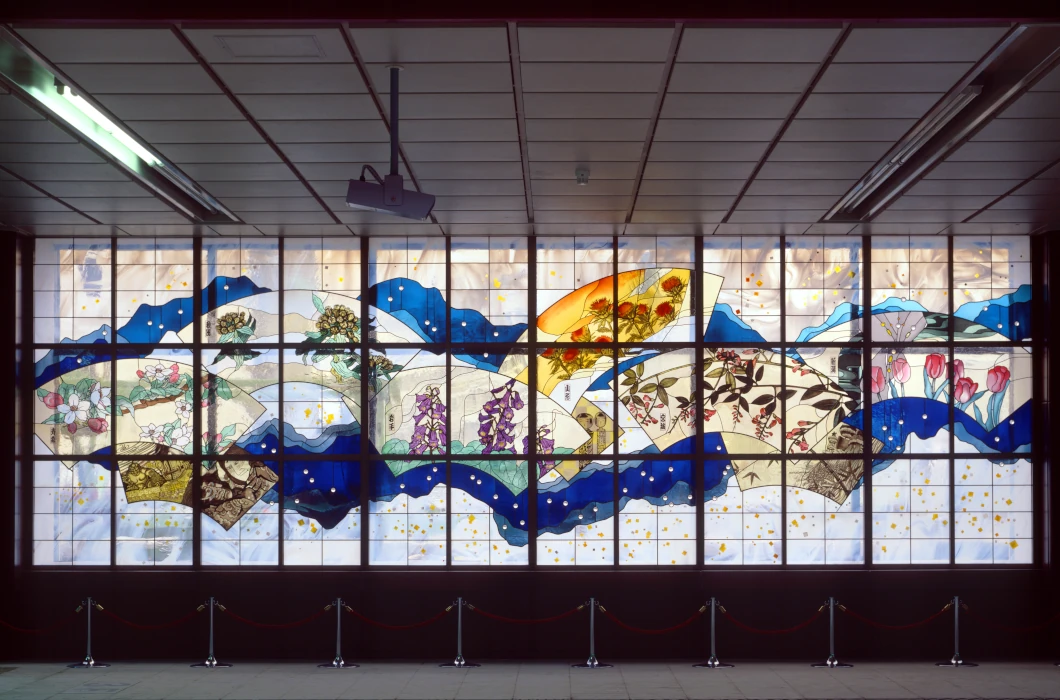
Left half of the Artwork

Right half of the Artwork


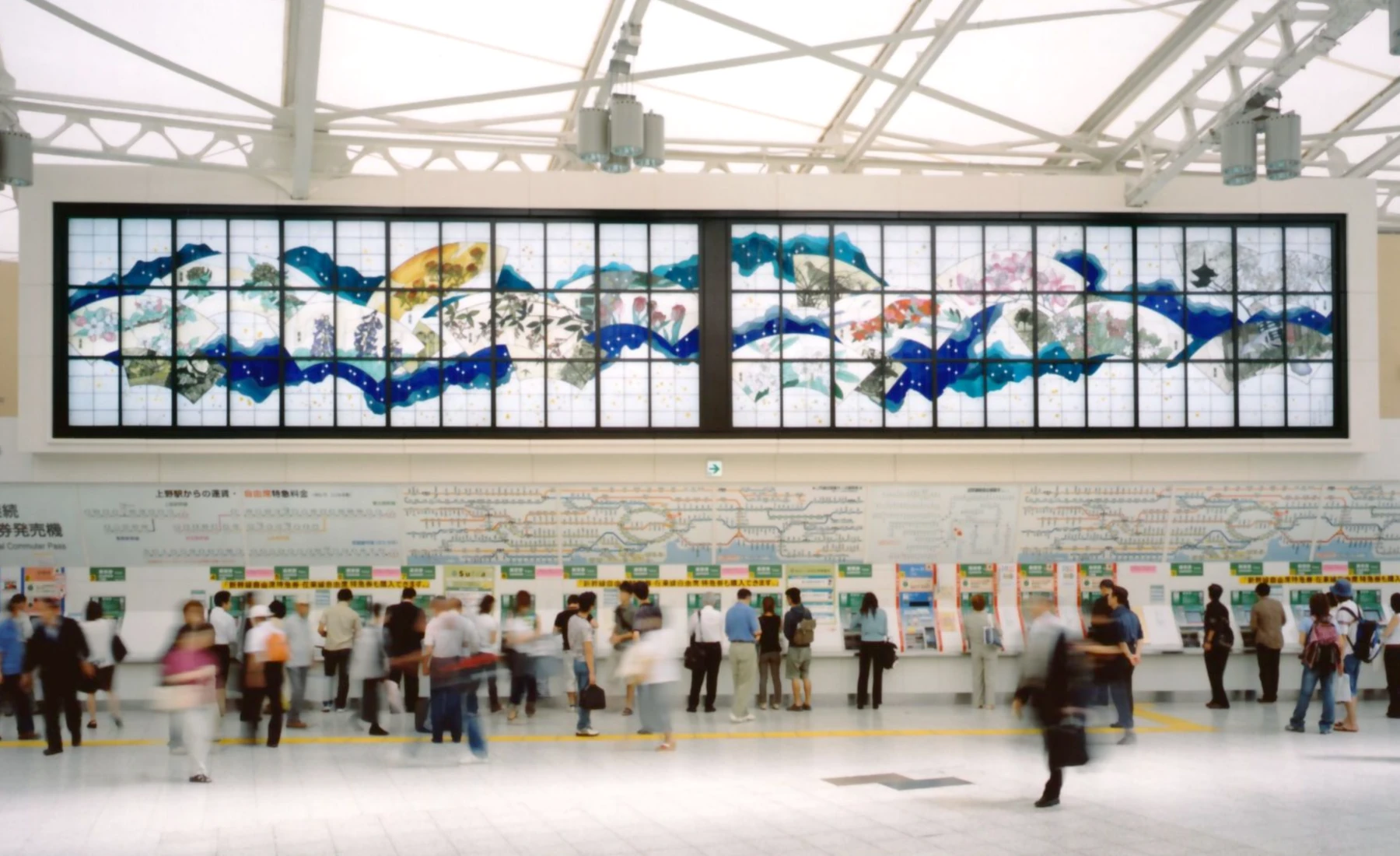
After relocation in 2002 (moved from the Shinkansen concourse to the central concourse). *Currently not on display; scheduled for reinstallation in FY2026.

At the time of installation in 1985 (Shinkansen concourse)
Planning : Japan Traffic Culture Association
Sponsorship : Matsushita Electric Industrial
Artist Profile
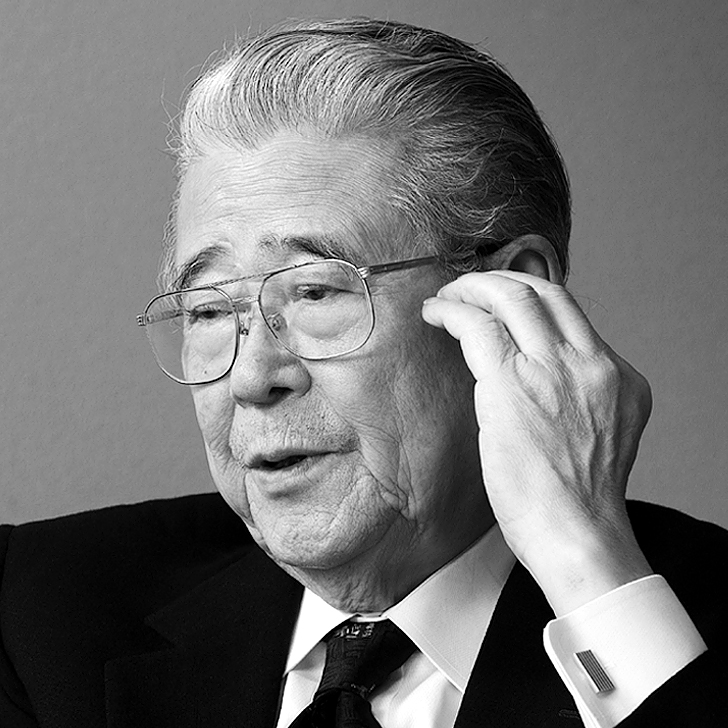
HIRAYAMA Ikuo
HIRAYAMA Ikuo
Japanese-style Painter
Born in Hiroshima Prefecture in 1930. Graduated from Japanese painting department, Tokyo Art School (currently Tokyo University of the Arts). An artist representing the contemporary Japanese painting society. In addition to the works with the Silk Road theme and the replica of Takamatsuzuka tomb mural painting, he developed "Cultural Property Red Cross" movement and has been highly evaluated internationally. Successively held the positions of Professor at Tokyo University of the Arts, Dean at the university, President of the university, Goodwill Ambassador and Special Advisor to World Heritage Site at UNESCO, Special Director of Tokyo National Museum, Representative Director of Foundation for Cultural Heritage and Art Research and so on. Received the Order of Culture in 1998. Passed away in 2009.Location : JR East Ueno Station (Currently not exhibited; scheduled for reinstallation at the same station)

Artist's Comments
With thoughts towards “North Hometowns”
The main point of this stained glass is that both composition and motif are Japanese. Since stained glass is originally from the West, most stained glasses have Western compositions and colors. In the European architectural style and climate, the harmony between thick buildings and various colors gives the impression of exquisiteness and solemnity, but it seems a bit different even if you adopt it in Japan as it is.
So I decided to try stained glass, a Western technique, with Japanese materials and composition. Although it is rather difficult to create a Japanese-style work with familiarity, I focused on planning first to integrate the East and the West.
This blue color which is the background is the color of “water”. It expresses the richness of the water and the richness of green in our country. At the middle of the whole picture, I collected colors of flowers such as cherry blossoms and azaleas. On the other hand, at the top and bottom, I kept using as little milky white change as possible. This water and green flow is abstract in a sense. And the framework to reinforce the stained glass, which you can accept as folding screens or sliding screens, was incorporated in the composition.
Due to its location, when the sun hits from the east, it shines in colorfully, and when the light comes in from the west, the town of Ueno participates. I wanted to show changes in spring, summer, fall, winter, whitening, turning green, every season. It is a Japanese idea to make good use of “between”, also called a margin.
And I wrote down the names of prefectures with the characteristic Edo letters in the fan screens. I think that they are also extremely Japanese-style tools. There is no screen like this in the West. Even though there are circular or spherical shapes, there is no space like a sector.In fact, I got a request to include something which is a symbol of the prefectures along the Tohoku and Joetsu Shinkansen line in making the original painting of this stained glass. Since there is no coherency even if I put them in pieces, I made centers by fan shape and put them in order from the east to the north. That is also an expression of the speed feeling of Shinkansen. Then I thought that I would draw Morning glory and Kaminarimon for Ueno and Asakusa or its representative flower for each prefecture in them.
Fans originally came from China, but Japan has completed such a form. There is a word of six bends for one set from ancient times, and in this stained glass, six folding screens are paired with a pillar sandwiched. A single folding screen can be an independent screen. It becomes a symbol of one prefecture. In that sense, a composition with excellent decoration can be taken. It can be said that each prefecture’s name tag is expressed in a fan.
Since it is a public art, even if it is a mosaic, a stained glass or ceramic board, it is troubled if you do not know well what was drawn on it. When coming back to your hometowns or going up to Tokyo, you will feel “Here is a home” with familiarity. It is my view that there is such a climate in Tohoku and Joetsu.
In the production, young assistants at Japanese-style painting in Tokyo University of the Arts actively helped. It is a big feature also that we all worked together. I think that this work will be a huge success if a square opens at the park entrance, various people gather in front of the stained glass, and they feel to spread a mat and eat lunches.