Oojishi (Large Lion) Cavorting with Butterflies


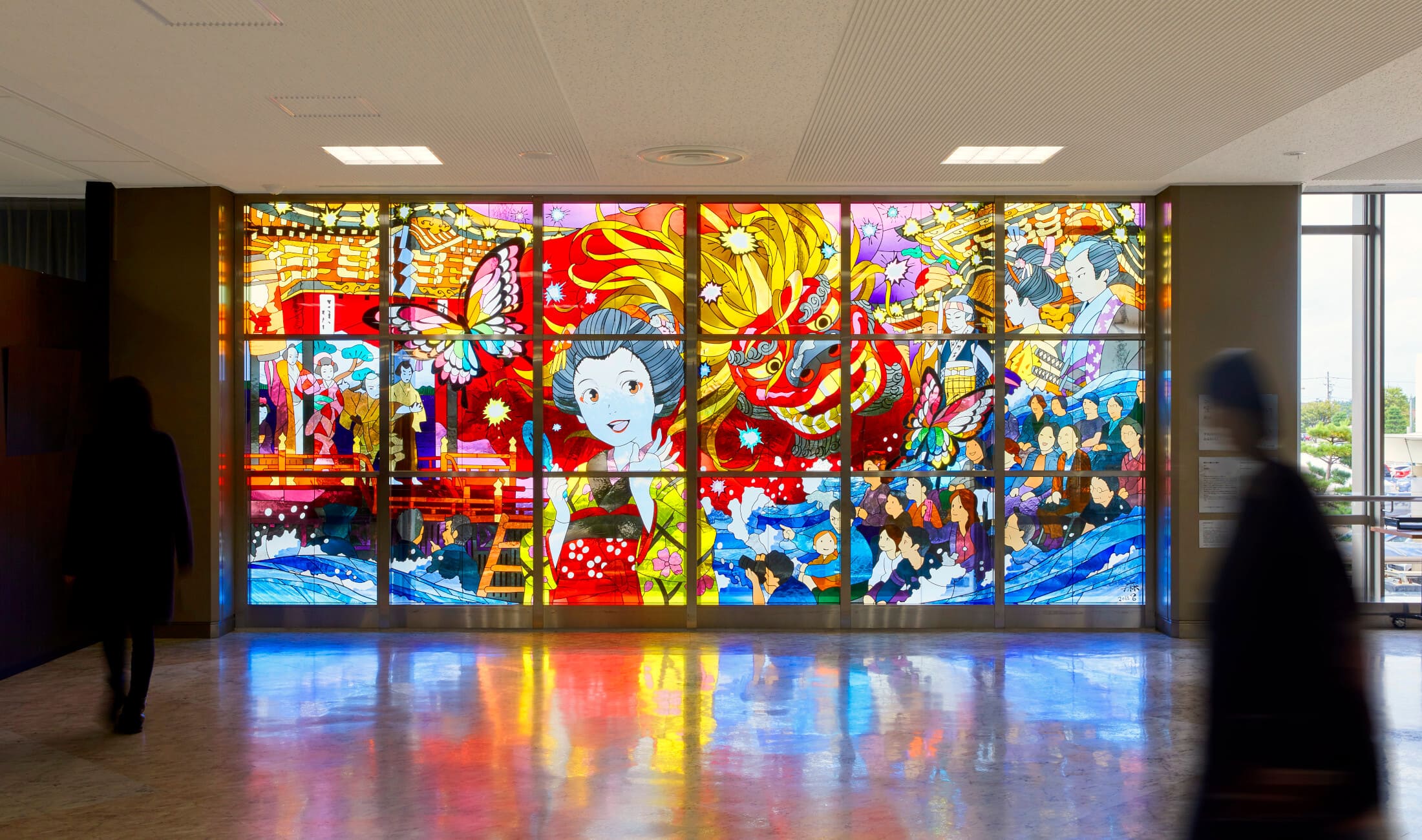
Original Painting and Supervisor |
Animation director YONEBAYASHI Hiromasa YONEBAYASHI Hiromasa |
|---|
2018
縦3.0m × 横7.0m
International Departure Lobby on 2nd Floor, Komatsu Airport
©YONEBAYASHI Hiromasa/STUDIO PONOC

Full view of the artwork (from the right)

Full view of the artwork


Close-up of the artwork (detail)

Close-up of the artwork (detail)

Close-up of the artwork (detail)
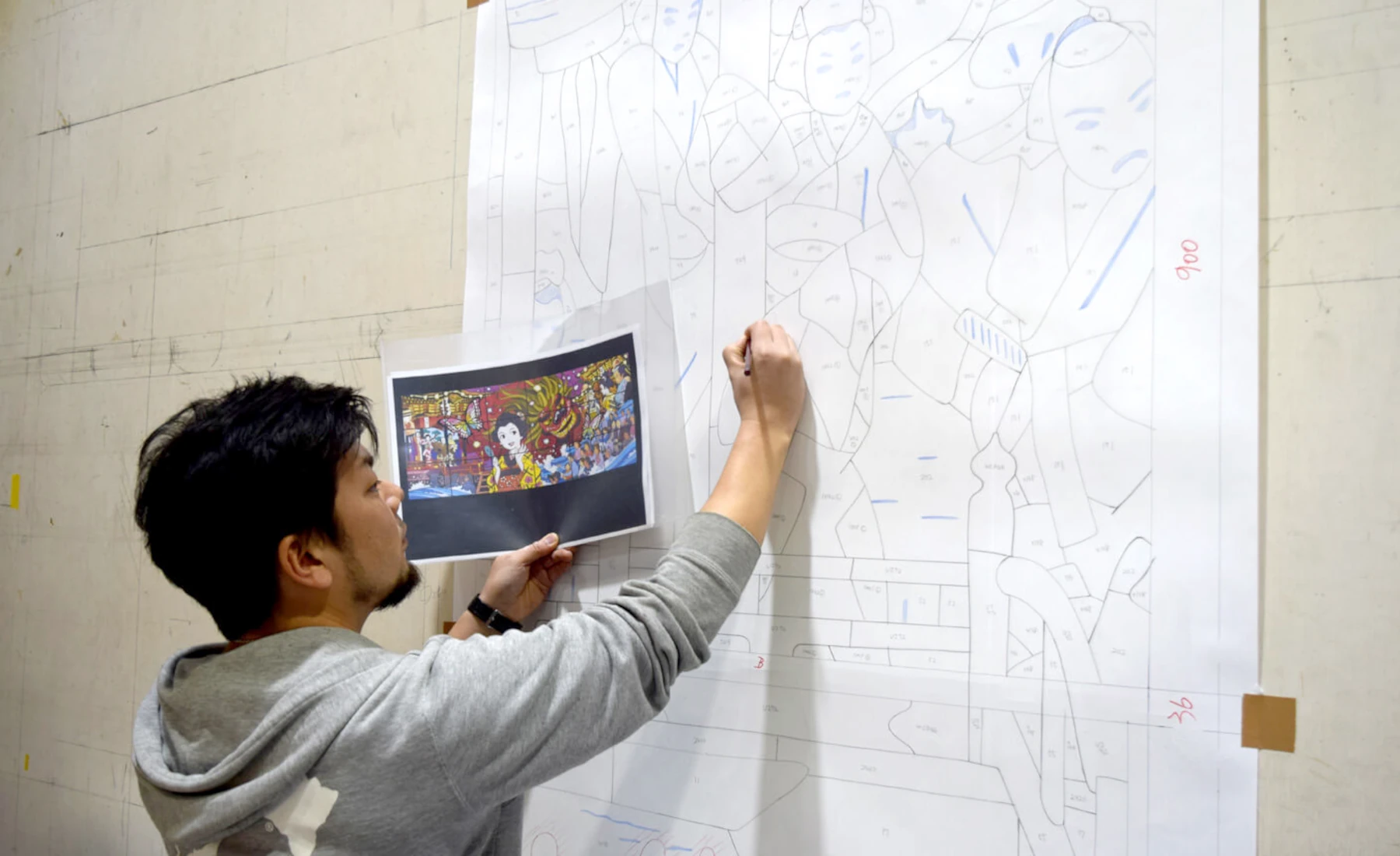
Based on the original painting, the artwork is “translated” into a full-scale production drawing.

The glass is cut using templates created from the translated design.

The glass is given special treatments, such as airbrushing.

The cut glass pieces are laid out to check the consistency of their colors and tones.

Mr. Yonebayashi, inspecting the art piece at the atelier.

Mr. Yonebayashi, painting on the picture.

Mr. Yonebayashi, painting on the picture.

Mr. Yonebayashi, painting on the picture.

Facial expressions and other details are painted onto the glass using grisaille, an achromatic pigment for lines and shading, and enamel, a colored pigment.

The glass pieces are joined with lead came and secured with solder using the traditional lead came technique.

Close-up of the artwork (detail)

Close-up of the artwork (detail)

Installed in the International Departures Lobby at Komatsu Airport.
Production Notes
“Oojishi (Large Lion) Cavorting with Butterflies” is a stained glass artwork whose original design and artistic supervision were by Hiroyasu Yonebayashi, one of Japan’s leading animation film directors, who was born in Nonoichi, Ishikawa Prefecture.
At the center of the composition are a young girl waving after finishing her makeup before going on stage, and a lion dance making its way from house to house during the Otabi Festival. Alongside them, children perform with dignified and earnest expressions, while adults cheer them on warmly. Together with the rolling waves of the Sea of Japan, these scenes are brought vividly to life in stained glass.
At the unveiling ceremony, Yonebayashi expressed his deep emotion and pride in seeing his work transformed into a stained glass artwork in his hometown. He also expressed his hope that the festival would continue across generations and that people would come to discover and appreciate the culture of Komatsu through the artwork.
Planning : Japan Traffic Culture Association
Sponsorship : Japan Lottery Association
This project was developed with a grant from the lottery social contribution public relations project.
Artist Profile

YONEBAYASHI Hiromasa
YONEBAYASHI Hiromasa
Animation director
Hiromasa Yonebayashi was born in Nonoichi-machi (it’s now Nonoichi City), Ishikawa-gun, Ishikawa prefecture in 1973. He dropped out of the Kanazawa College of Art’s Commercial Design Course.He joined Studio Ghibli in 1996 and did inbetweening for “Princess Mononoke” (1997) and “My Neighbors the Yamadas” (1999). For “Spirited Away” (2001), he was in charge of key animation for the first time. Mr. Yonebayashi was also key animator for “Ghiblies episode 2” (2002), “Howl’s Moving Castle” (2004) and “Ponyo” (2008). He worked as assistant animation director for “Tales from Earthsea” (2006). He was the technical director and animation supervisor for the original short film, “Mei and the Kittenbus” (2002), for the Ghibli Museum, Mitaka. He was also the animation director for the film, “Imaginary Flying Machines” (2002), for the museum. For the permanent exhibition, “Film GuruGuru,” he created the storyboard and was technical director and animation supervisor for “Evolution Theory”. His directorial debut was for “The Secret World of Arrietty ”, released in 2010. The movie was the top-selling movie in Japan with a record 7,650,000 tickets sold and 9.25 billion yen in box-office revenue. His second movie as director, “When Marnie Was There”, was nominated for ‘Best Animated Feature’ at the 88th Academy Awards.
After leaving Studio Ghibli, “Mary and The Witch’s Flower”, released in the summer of 2017, was his first feature film for Studio Ponoc, Inc.
Location : International Departure Lobby on 2nd Floor, Komatsu Airport

Artist's Comments
The “Otabi Matsuri” festival is held every May in Komatsu City, IshikawaPrefecture.
I created the design of this stained glass window based on the festival’s famous “Children’s Kabuki” performed on “Hikiyama” festival floats. You can see the children transformed into splendid kabuki actors acting on the golden lit-up floats, engaging and exciting the audience. In the center is a child in kabuki makeup offstage enjoying a carefree moment. While we often see photographs of children performing kabuki, rarely do we see these children depicted offstage.
Behind the child in the center is the “Shishimai” (Lion Dance) which is performed house-to-house during the festival. It is said that the Lion Dance expresses the “Oojishi” (large lion) cavorting with butterflies. The children performing Kabuki seem to have transformed into butterflies, and the rolling waves of the Sea of Japan depict the audience’s support and cheers for them.
I hope the “Otabi Matsuri” festival will continue to be held each year for generations to come, and that this stained glass window will help travelers visiting Komatsu Airport learn about this wonderful event.